
Stronger SNS DAO Design: How Can DeFi on ICP Become Safer?
The real competition among top-tier DeFi protocols is not just about features. It is about long-term institutional capability. What SSS wants to add is not another DAO, but a safety layer between governance and execution.
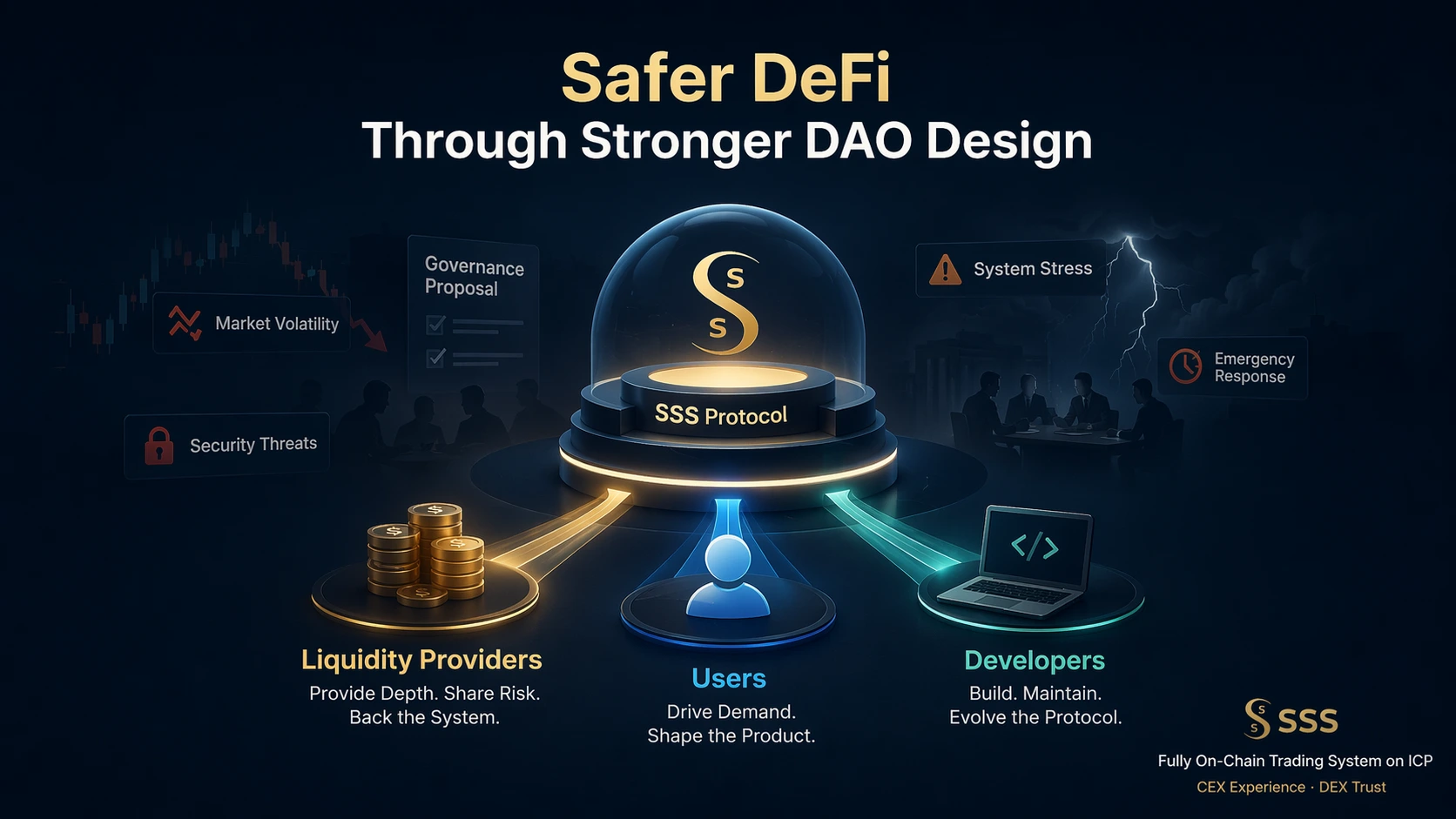
- The essence of top-tier DeFi is not just product capability, but the ability to operate stably over the long term.
- A real DAO is not just token issuance plus voting. It is the long-term alignment and coordination of LPs, users, and developers.
- SNS is a strong foundation for primary governance, but DeFi still needs an added layer of protection for high-risk execution after governance decisions are made.
- What SSS wants to add is not another DAO, but an institutional foundation where governance, execution, and protection each have their proper place.
Stronger SNS DAO Design: How Can DeFi on ICP Become Safer?
What SSS wants to add is not another DAO, but an institutional foundation that helps top-tier DeFi survive and evolve over the long term.
Many DeFi projects compete on four things in their early stages: how many features they offer, how fast they feel, how strong the incentives are, and how quickly they can grow TVL. But the projects that actually become leaders — and stay alive over time — are ultimately judged by something deeper:
- risk management institutions
- continuity of operations
- clear responsibility boundaries
- emergency response and recovery under stress
- whether the system can keep running even as the founding team gradually steps back
That is the real issue.
So when SSS discusses DAO design, we are not simply repeating the usual “token launch + voting” narrative. What we actually care about is this:
Why must top-tier DeFi design its DAO as a long-term operating system, rather than a short-term governance tool?
SSS has never aimed to be just another DEX on ICP. We want to build a trading system that meets a top-tier DeFi standard: stronger product capability, but also a more credible institutional foundation.
CEX experience, DEX trust.
1. A real DAO is not “token launch + voting.” It is the long-term alignment of three core participants.
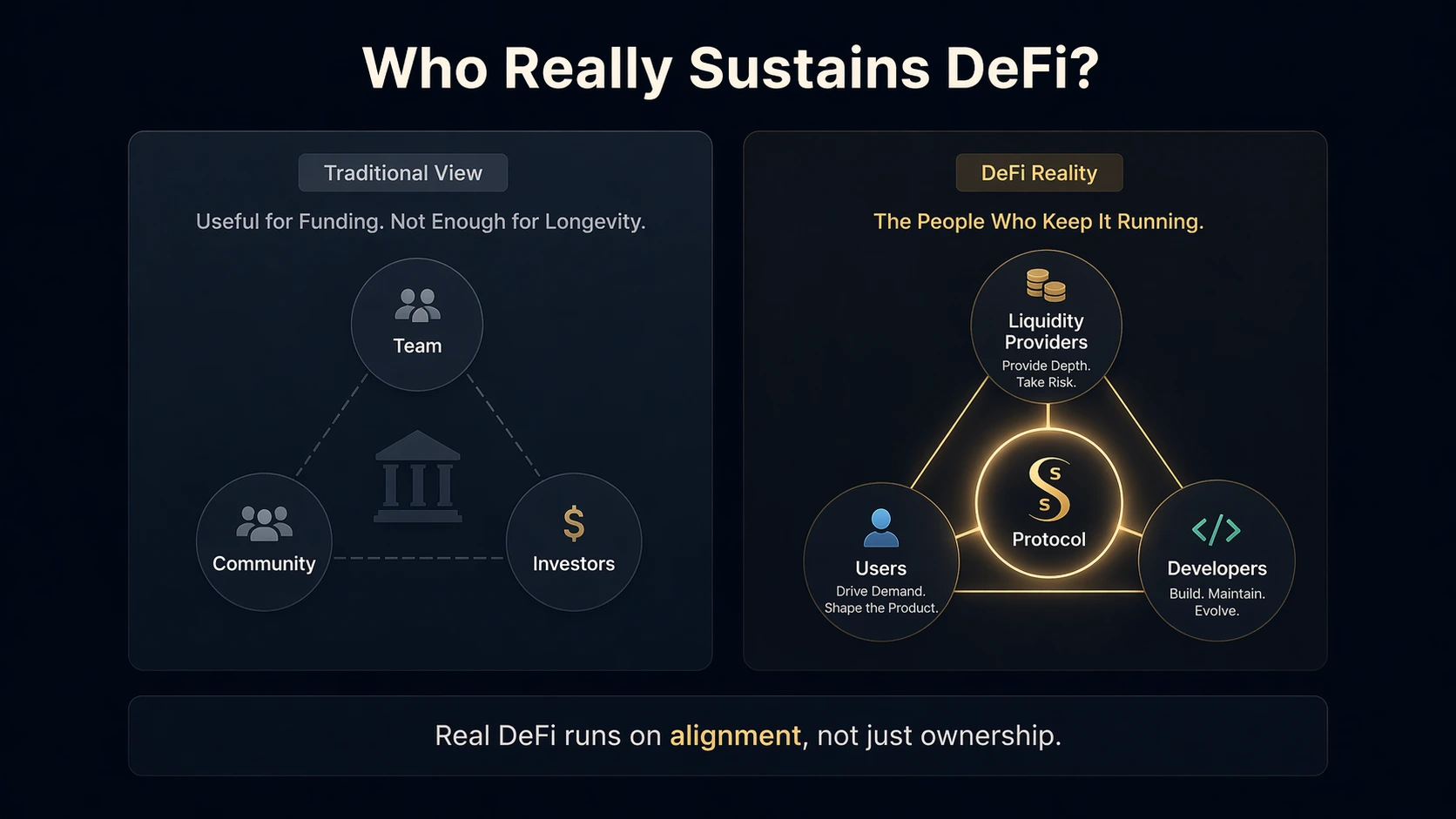
Many projects still talk about DAOs using the old framework of “team / community / investors.” That framing can be useful for fundraising, branding, and early-stage storytelling, but it does not accurately explain why a DeFi system can survive over time.
In DeFi, the parties that truly sustain the system are not an abstract “community,” but three more concrete groups:
| Core participant | Why it matters |
|---|---|
| Liquidity Providers (LPs) | They bear system-level capital risk and determine market depth and resilience. |
| Users | They determine real demand, trading activity, and product direction. |
| Developers / Maintainers | They determine whether the system can be continuously fixed, upgraded, and evolved. |
So a real DAO is not about handing governance power to “everyone” in the abstract, nor is it about issuing a token and asking people to vote.
A real DAO should do this instead:
Create a more stable structure of aligned incentives and coordinated responsibility among the people who actually sustain the system over the long term.
That is more meaningful than talking about decentralization in the abstract. Because the deeper question is not ideological — it is practical:
Why can DeFi survive over time, instead of losing direction after one crisis, one major disagreement, or one transition in leadership?
2. Existing DeFi and SNS have already shown one thing: the problem is not just who governs, but how governance is executed safely.
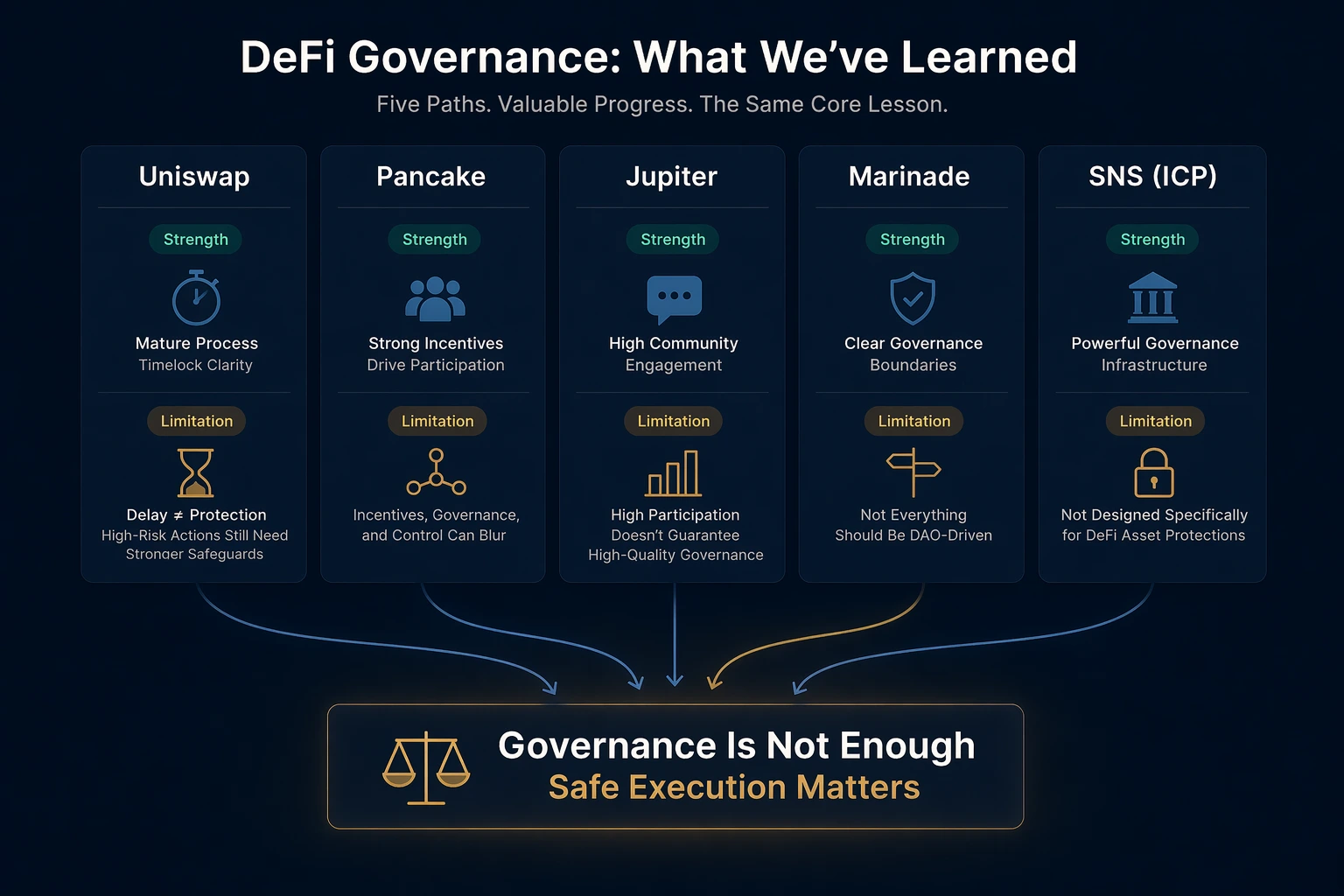
Over the past few years, top-tier DeFi protocols and SNS have already provided many useful lessons. They show that DAOs matter — but also that DAO design alone is not the full answer.
| Path | What it has proven | What it still exposes | What SSS learns from it |
|---|---|---|---|
| Uniswap | Mature process and clear timelock design | Delay is not the same as execution protection | High-risk actions need a clearer protective layer |
| Pancake | Incentives and participation can scale quickly | Incentives, governance, and control can become entangled | Different forms of power should not be collapsed into one |
| Jupiter | Strong community participation | High participation does not guarantee high-quality governance | Activity is not the same as institutional maturity |
| Marinade | Clearer governance boundaries | Not everything should be handed to a DAO | A mature DAO must have boundaries |
| SNS (ICP) | A strong foundation for primary governance | Not specifically designed for DeFi asset-boundary protection | Strong as a base governance layer, but DeFi still needs execution safeguards |
The conclusion behind this table is simple:
For DeFi, the real question is not just “who governs,” but “how governance decisions are executed safely after they pass.”
SNS is strong at answering one question: who gets to decide. But for DeFi, we still need to ask more:
- Can high-risk upgrades take effect immediately?
- Can asset-path changes go live directly?
- Can parameter changes touch capital boundaries too quickly?
- Do users have room to exit when there is disagreement or uncertainty?
What users feel first is not an abstract governance model, but practical guarantees: whether rules can suddenly change, whether asset boundaries are clear, whether they can exit under stress, and whether the system can keep operating even when the team or governance structure runs into trouble.
That is why DeFi DAO design cannot stop at voting. The hard part is high-risk execution protection after governance.
3. The founder’s job is not to control forever. It is to build the base well, then decentralize gradually.
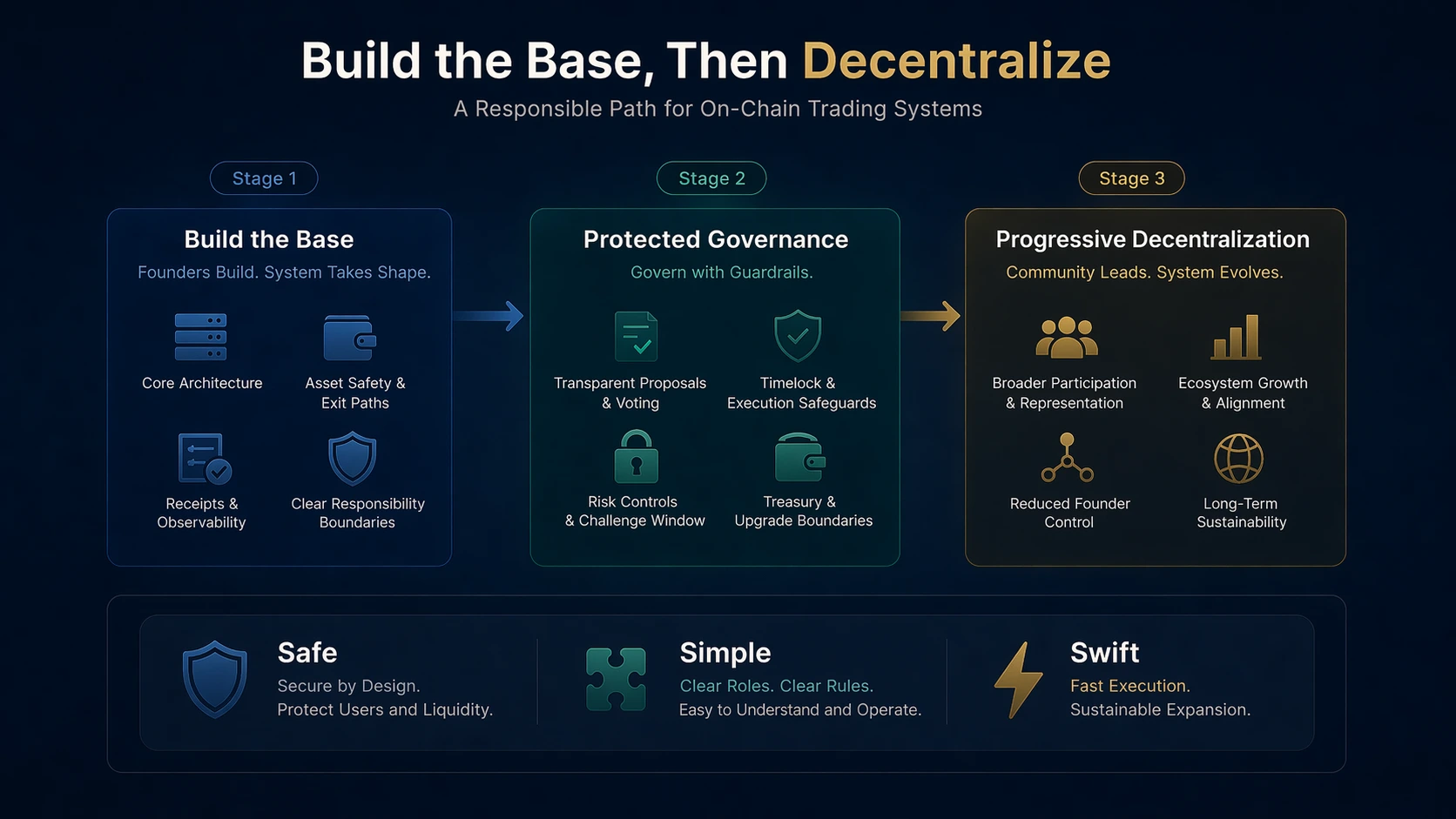
This is where SSS differs from many projects that follow the sequence of “launch token first, add governance next, repair the institution later.”
Our view is different: the founder’s role is not to retain control forever, but to build a strong foundation first and then hand over power gradually.
This is also how the three core values of SSS extend from product design into institutional design:
Safe
Build the safety boundaries, risk controls, exit paths, and protection layers first.
Simple
Keep governance boundaries clear and role design understandable. Avoid overcomplicated power structures.
Swift
Not speed without safeguards, but speed that can scale sustainably because trust is preserved.
So SSS believes in the following sequence:
Build the system solidly first, then hand over power. Not decentralization for its own sake, but decentralization in service of long-term survival.
That is more mature — and more credible — than simply saying “we want a DAO.”
Because real efficiency is not about making everything executable immediately. Real efficiency means:
- users feel safe keeping assets in the system over time
- LPs are willing to continue providing depth
- developers are willing to keep maintaining and improving it
- the founding team is confident enough to decentralize step by step
- the protocol is strong enough to support higher-value assets over time
That is why SSS defines efficiency this way:
The ability to keep expanding without sacrificing asset safety or governance credibility.
4. TVL Protection Layer: not a second DAO, but a firewall for high-risk execution.
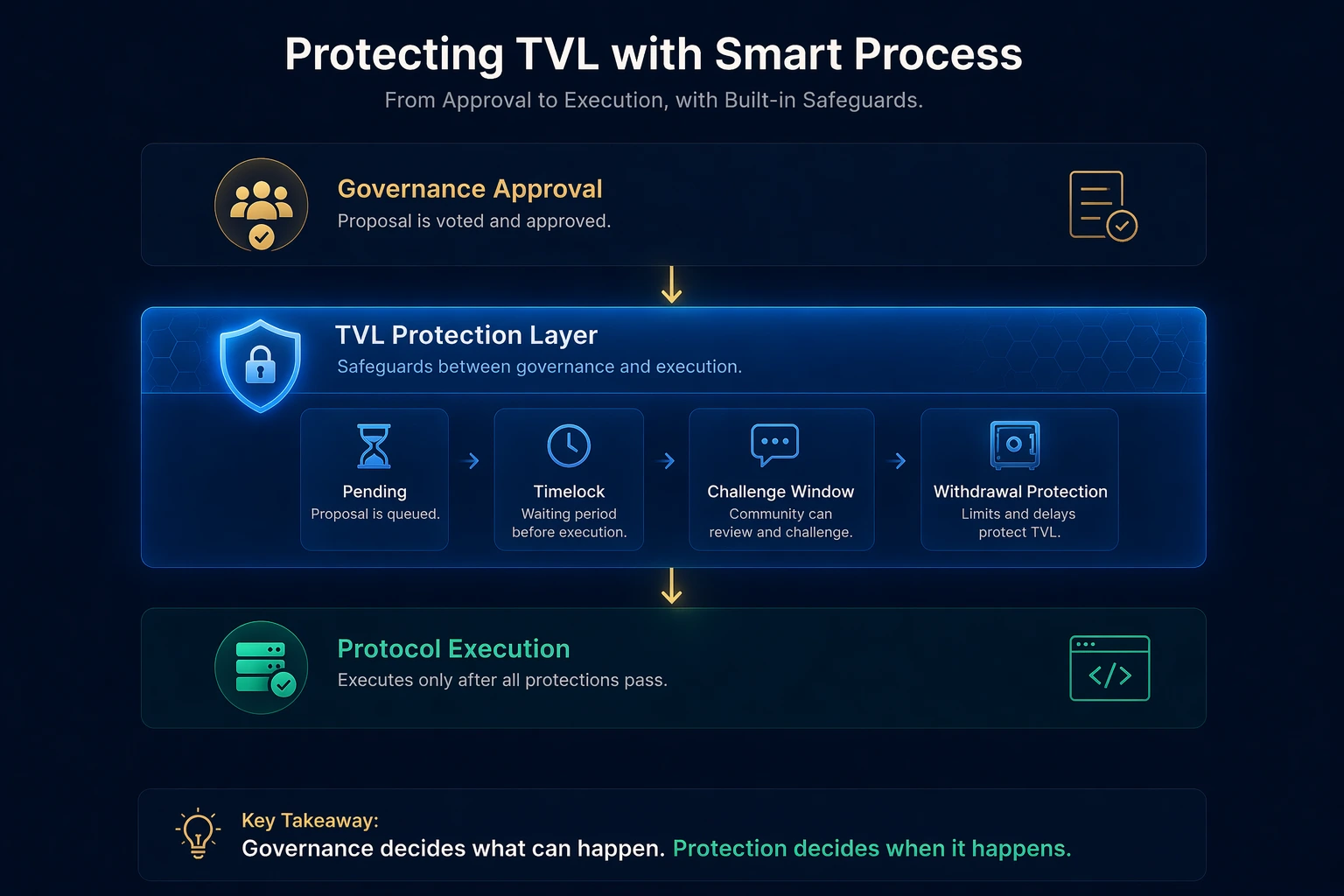
This is the most important part of the article.
The TVL Protection Layer is not a “second DAO,” and it is not about giving LPs extra ruling power. It is explicitly not the following:
- not a day-to-day governance layer
- not a treasury management layer
- not a general veto layer for ordinary proposals
- not “whoever has the largest TVL decides”
Its essence is very simple:
It is a highly restrained protective mechanism that only becomes active for high-risk execution actions.
Why is it needed?
Because in DeFi, the people and capital most exposed to systemic risk are not only token holders. They also include participants who provide liquidity over time and keep real funds inside the system. That capital should not be treated as a passive resource. In rare but truly high-risk scenarios, it should have a limited but meaningful form of protection.
A more reasonable logic looks like this:
Governance proposal passes
        ↓
Identified as a high-risk execution action
        ↓
Moves into Pending instead of executing immediately
        ↓
Triggers timelock / challenge window / withdrawal window
        ↓
Executes only after conditions are met; if protection is triggered, it is delayed, reviewed, or blocked
Its powers must also remain narrow and restrained. They should only include:
- Challenge
- Extend Timelock
- Conditional Block / Veto
- Withdrawal Protection Trigger
So the real meaning of the TVL Protection Layer is not “give LPs more power.” It is this:
Give capital that bears long-term systemic risk a form of institutional protection during high-risk execution scenarios.
That is critical. Because it protects liquidity directly, but also strengthens user confidence, reinforces developer responsibility, and stabilizes the governance structure of the protocol as a whole.
5. Conclusion: SSS wants to build not just a stronger product, but stronger long-term institutional capability.
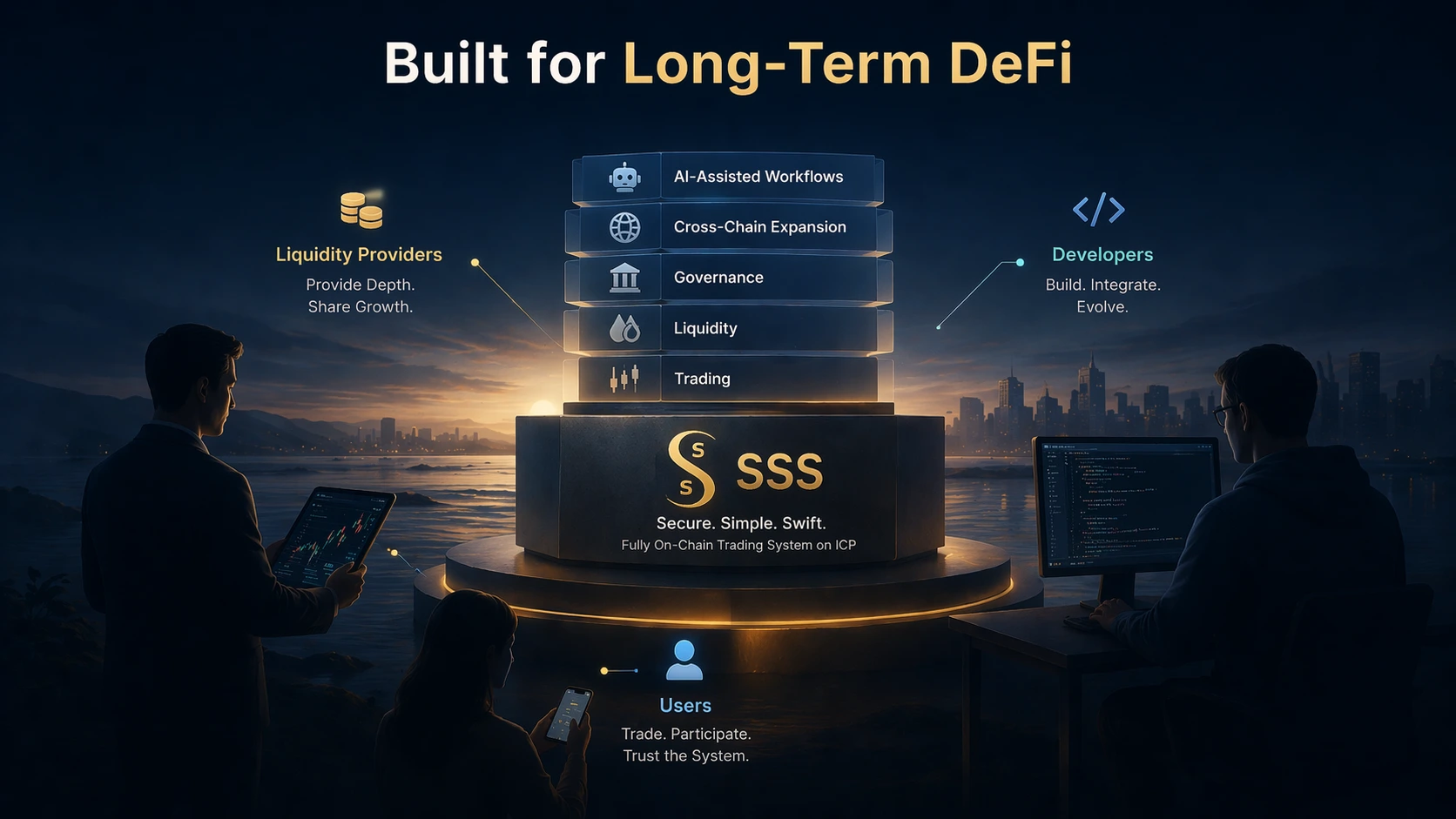
SSS does not just want to be a faster trading system. And it does not want to become merely a DAO that is “better at voting.”
What we want to build is an institutional foundation that can support a top-tier DeFi system over the long term — one that can remain stable, decentralize progressively, and continue evolving.
The founder’s responsibility is to build that base first: to make the product, execution model, boundaries, protection, and emergency capabilities solid under the principles of Safe, Simple, Swift. On top of that, governance and protection structures can gradually expand, so that LPs, users, and developers can form a stronger long-term alignment of interests and responsibilities.
So the core point of this article is actually very simple:
The real competition among top-tier DeFi protocols is not just feature competition. It is competition in long-term institutional capability.
And what SSS wants to add is precisely the layer that is easiest to overlook, but most decisive for long-term success:
A system in which governance, execution, and protection each have their proper place.