
Leaving Behind the Costly Old Road of Cross-Chain Bridges: Why SSS DeFi Is Building a Safer Full-Chain Trading System
Starting from recent cross-chain bridge failures, this article examines the deeper reasons bridge risks keep recurring, and explains why SSS is taking a different path with chain-key assets, an internal ledger, a full-chain architecture, and more deliberate onchain governance.
- Recent bridge incidents reveal not only isolated exploits, but a deeper structural problem: external verification paths are still being allowed to define internal asset truth.
- Historical cases such as Ronin, Wormhole, Nomad, and Multichain show recurring patterns around verification failure, concentrated control, configuration mistakes, and excessive coupling between external funding rails and internal credit.
- SSS is being designed to demote external rails to funding entry and exit, while keeping trading truth inside the system.
- Chain-key assets, an internal ledger, a full-chain architecture, and more deliberate DAO design together create a clearer and more verifiable system boundary.
Leaving Behind the Costly Old Road of Cross-Chain Bridges: Why SSS DeFi Is Building a Safer Full-Chain Trading System
Recent bridge failures are a reminder that the real danger is often not a single bug, but a system that allows external verification paths to define internal asset truth. SSS is being built to avoid exactly that.
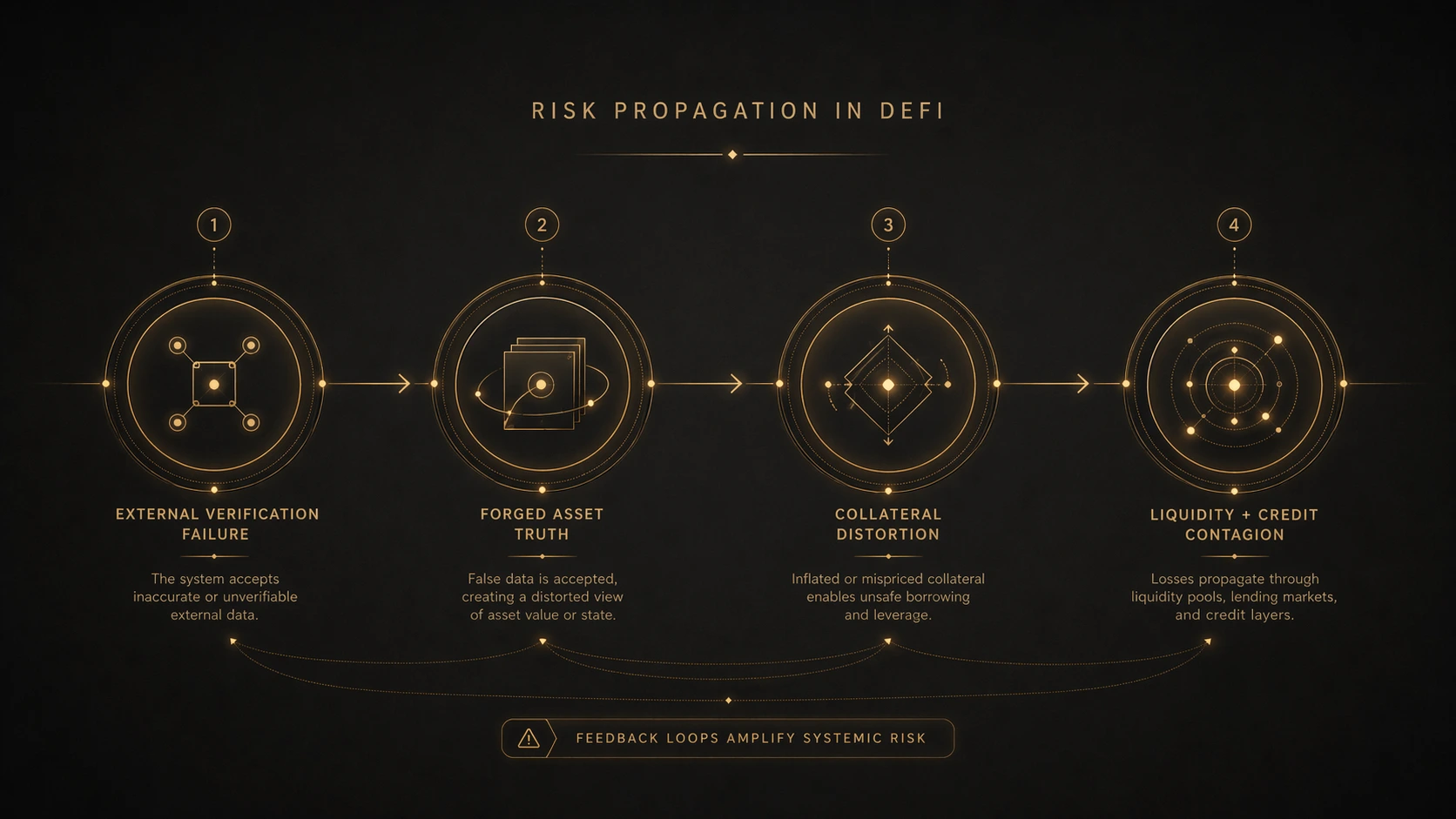
The recent Kelp / LayerZero / rsETH incident looked, on the surface, like yet another bridge exploit. In reality, it exposed a deeper issue: when an external verification path is powerful enough to define internal asset credit, a failure in observation or verification can quickly turn into a broader liquidity and solvency event.
According to Aave’s incident report, the attacker exploited Kelp’s LayerZero V2 Unichain → Ethereum rsETH route, which used a 1-of-1 DVN setup, forged an inbound packet with no corresponding source-chain burn, and caused 116,500 rsETH to be released. The problem then spilled over into lending markets. LayerZero’s own incident statement described the direct trigger as a compromise of the RPC infrastructure used by its DVN, combined with DDoS pressure that contributed to incorrect validation.
What matters here is not only that a bridge failed. What matters is why a bridge result could so directly become internal asset truth. Once a bridge message, a validator signature, or a single route output is treated as immediately equivalent to freely usable, fully trusted onchain credit, bridge risk no longer stays at the perimeter. It becomes a risk to the system’s balance sheet.
What This Incident Actually Revealed
1) The issue was not just a forged message. It was that a forged message could release high-value assets.
At the most technical level, the incident involved a forged cross-chain message being accepted as valid. But the more important point is structural: the system treated “verification passed” as “the asset is real.” That meant a failure in the verification layer did not remain a verification problem. It became an asset-truth problem.
This is why Aave’s report matters so much. It did not merely describe how 116,500 rsETH was released. It showed how a bridge-route failure could quickly propagate into collateral, borrowing, and liquidation risk.
2) A single-verifier design turns a service problem into an asset-release problem.
If a high-value route uses a 1-of-1 validation structure, then the problem is not simply lower reliability. The real problem is that a single judgment source is granted too much power.
In this case, the 1-of-1 DVN design was not a side detail. It was a central amplification factor. It transformed what should have been an issue at the observation or verification layer into a release-of-assets issue with system-wide consequences. See Aave’s report and LayerZero’s statement.
3) Default configurations, documentation examples, and fuzzy production responsibility remain an industry weakness.
Many major incidents do not happen because teams intentionally choose the most dangerous setup. They happen because a configuration that is merely “usable” gets mistaken for one that is “production-safe.”
LayerZero’s own integration checklist explicitly says production deployments should set libraries and DVNs explicitly and should not rely on defaults. In practice, however, many teams still treat a default path or a quick-start example as if it were equivalent to a hardened production design.
This gap between “works in engineering” and “safe in production” is itself a systemic risk.
4) Once bridge output becomes internal credit, local failures can be magnified by DeFi composability.
The largest risk in bridge systems is not that they are standalone modules. It is that they rarely remain standalone modules.
As soon as bridge-derived assets are used in trading, lending, collateral, liquidity provisioning, or structured yield strategies, a bridge failure is no longer just a deposit problem. It can become a broader solvency and confidence problem. That is exactly why the recent rsETH incident mattered far beyond a single protocol. See Aave’s incident report.
This Was Not an Isolated Case
The details differ from case to case, but the pattern is familiar.
| Incident | Core Failure | What It Really Taught the Industry |
|---|---|---|
| Ronin (2022) | Validation power was too concentrated. Attackers gained control of 5 out of 9 validators and exploited lingering permissions. | Bridge security is often determined less by surface-level decentralization than by who can actually control the critical path. |
| Wormhole (2022) | The verification process was bypassed, allowing assets to be minted without the proper backing. | If message verification fails, asset truth fails with it. |
| Nomad (2022) | A bad initialization of trusted roots allowed unverified messages to be treated as valid. | Many bridge failures are not exotic mathematical bugs, but mistaken assumptions about what has or has not been verified. |
| Multichain (2023) | The risk did not come from code alone, but also from control, key management, and operational boundaries. | A bridge is a composite system of code, keys, operations, and governance. Its failures are often composite too. |
Taken together, these cases show that bridge failures tend to revolve around the same recurring themes:
- verification truth breaks down;
- control becomes too concentrated;
- defaults or state configuration are mistaken for security;
- external funding rails become too tightly coupled to internal credit truth.
Once these problems meet DeFi composability, a local failure can quickly become a system event.
Why SSS Is Taking a Different Path
1) SSS does not treat bridges as the trading core. It tries to demote them to funding rails.
This is not just a matter of “using fewer bridges.” It is about placing risk in the right location.
In many systems, once a bridge route validates, the asset can immediately enter trading, collateral, lending, and liquidation loops. SSS is being designed so that external rails are primarily used for funding entry and exit, while trading truth remains inside the system.
That difference matters. If an external path fails, it is far better for it to fail as a funding-rail issue than as a direct rewrite of the trading system’s internal truth.
2) On ICP-native asset paths, SSS is aligned with the chain-key token model, not the traditional wrapped-bridge model.
This is one of SSS’s strongest structural advantages.
According to the Internet Computer documentation, chain-key tokens are created using ICP’s chain-key cryptography, are backed 1:1 by native assets held fully onchain by smart contracts, and do not rely on intermediaries or centralized bridges. The ICP learning resources further describe chain-key tokens as a stronger and more decentralized alternative to wrapped tokens.
For SSS, this means that at least within ICP-native asset paths, the starting point is already different: the system is not trying to cosmetically improve the old bridge model. It is building on an asset model that was designed to avoid that trust pattern in the first place.
3) The internal ledger is not only about user experience. It is about risk separation.
An internal ledger is often understood only as a way to make a DeFi product feel more like a full-featured exchange. That is true—but incomplete.
Its deeper value is structural. It allows the system to distinguish between:
- external asset arrival,
- internal available balance,
- trading state,
- and risk state.
That separation is crucial. It gives the system room to treat high-risk external flows as pending, restricted, claimable, or otherwise conditional, instead of instantly promoting them to unrestricted internal credit.
The internal ledger is not a substitute for security. It is part of the structure that makes better security possible.
4) A full-chain architecture matters because it shortens the trust boundary.
For a trading system, what matters is not simply whether some modules are “onchain.” What matters is whether the critical path is short enough, coherent enough, and verifiable enough.
The Internet Computer’s chain-key model and network governance framework both emphasize onchain verifiability, reduction of intermediaries, and decentralized control.
For SSS, a full-chain architecture is not only a deployment style. It is a way to make execution, records, presentation, and governance easier to reason about within a clearer boundary.
5) A more deliberate DAO design is meant to govern high-risk boundaries, not just visible features.
A DAO that is only about tokens and votes does not solve the class of problems exposed by bridge incidents.
The SNS framework on the Internet Computer is designed so that a community can govern a dapp’s code, parameters, data, and frontends fully onchain. More importantly, it provides a direction for governing the boundaries that actually matter in production systems: upgrades, risk parameters, asset listings, emergency controls, and operational authority.
For SSS, a more deliberate DAO design is not meant to add political theater. It is meant to progressively place the highest-risk powers inside a more transparent and more verifiable governance structure.

What SSS Is Really Trying to Solve
SSS is not claiming to eliminate all external risk.
The more honest claim is different.
SSS is trying to:
- prevent external funding rails from becoming the truth-defining layer of the trading core;
- avoid treating bridge output as immediate, unrestricted internal credit;
- avoid building the core trading experience on fragmented and opaque third-party dependencies;
- and converge the critical path into a shorter, clearer, and more verifiable onchain system boundary.
That is why SSS emphasizes chain-key assets, an internal ledger, a full-chain architecture, and a more deliberate governance path. These are not isolated product features. Together, they form a system method: keep external dependency risk at the perimeter, keep trading truth inside, and make the highest-risk powers more transparent over time.
Conclusion
Recent bridge incidents should not be understood merely as isolated project failures. They are better understood as industry-wide reminders that DeFi still needs a more mature answer to three questions:
- What defines asset truth?
- Where does verification authority really sit?
- How much of the critical path depends on hidden external trust?
The rsETH incident made these questions visible again.
SSS’s choice to build around chain-key assets, an internal ledger, a full-chain architecture, and more deliberate DAO design is not about telling a more complicated story. It is about putting the most important parts of the system inside a shorter, clearer, and more verifiable boundary.
This does not mean the work is finished.
But it does mean that from the very beginning, SSS has been trying to avoid a path that the industry has already shown—repeatedly—to be expensive, fragile, and strategically outdated.
SSS is not trying to build a prettier DeFi interface.
It is trying to reorganize trading into a more complete, more coherent, and more verifiable onchain system.
Related Links
Recent incident
Historical cases
- Ronin — Back to Building: Ronin Security Breach
- Chainalysis — Wormhole Hack Analysis
- Google Cloud / Mandiant — Dissecting the Nomad Bridge Hack
- Chainalysis — Multichain Exploit Analysis